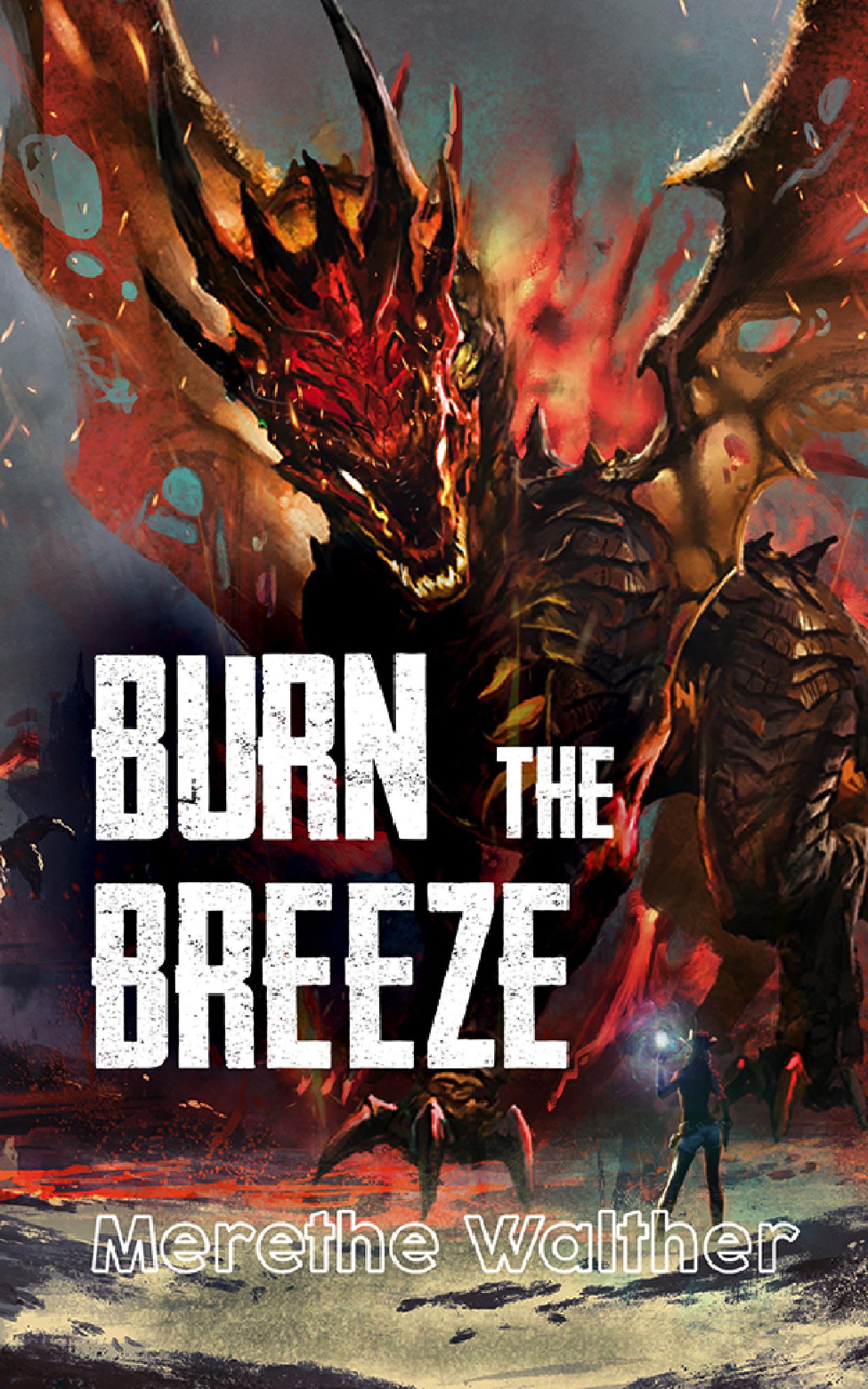
New release announcement!

Blog Articles

If you haven’t had a chance to pick up Trailblazer, the first book in my “Baptism by Fire” series, then now is a good time, as the second, and final book in this series—for now, at least—is going to be out soon!

Trailblazer’s fiery conclusion, Burn the Breeze, will be released on August 15, 2024!

*cue trumpets and fanfare*

I am currently working with my incredibly talented cover artist, Thea Magerand, to get the wraps done so the paperback copies for both will be available soon—possibly even in time for release day, which I’m really excited about.

I mean, c’mon, who wouldn’t be? Her art is exceptional.

Although I was originally planning on releasing Burn the Breeze a little later in the year, I have a lot of upcoming edits for some other series I’m working on and then of course *gestures vaguely at everything* and didn’t want to chance it being delayed.

Et voila, early book release.

Both Trailblazer and Burn the Breeze will be available in KindleUnlimited and in paperback (shortly), so grab your copy of the first, and pre-order the latter today!

How to Fake-Out Paranormal Romance Readers

Blog Articles

This is a silly-but-honest review for the book How to Fake-Date a Vampire by Linsey Hall. There will be spoilers ahead, so if you have yet to read this book and it’s on your TBR list, I suggest not reading past the marked spoiler area below.

How to Fake-Date a Vampire is the second book in the Charming Cove series by Linsey Hall. It’s a standalone cozy romance novel, so you can jump right in.

The premise is simple: Emma is a witch trying to prove herself to her coven by finding the perfect location to host the important magical soiree. Through a series of zany run-ins, she winds up agreeing to pretend to be in a relationship with the local vampire duke, Alaric.
By being his “fake” girlfriend, she’ll get access to his ultra posh, ultra exclusive duchy for said magical event, and he will get to keep his beloved grandmother from finding out that his last relationship went south in a bad way following the betrayal of his ex-girlfriend, who sold family secrets to the press.

Regrettably for me, How to Fake-Date a Vampire is my first, and likely last, foray into Charming Cove. Concept wise, the story sounded promising, and I was interesting to see a light paranormal romance with a cute “candy floss” kind of read.
This book, however, oversold on its main premise: That of being a paranormal romance, which was… not great right out of the gate, tbh.
This book ended up being a bit frustrating to get through because of nonsensical choices, missing plots, McGuffins galore, and indecisive characters badly in need of self-agency and clear motivation/drives.

On a scale of 1-5 stars, I rated this a two, only because I don’t like one-starring books unless they really deserve it, and this one didn’t. Also, because while I have an excessive amount of gripes and snarky commentary, there genuinely were parts of this book I felt were enjoyable… even though I had to fight for those moments among the rest of the novel, which largely pancaked it, in my opinion.

I wanted to love this book—I really did. A cute, cozy romance involving witches and vampires? Count me in!
However, this story almost immediately fell apart within the first 100 or so pages. There were aspects of it I did enjoy and thought were cute, like the sweet, snack-eating skunk, Penelope, who is one of my favorite characters in the entire book (scratch that, she is my favorite). But ultimately, having failed at its first and foremost promise to give us supernatural magical creatures having a cutie li’l romance, I was already in for disappointment.

(Barring Penelope, naturally. As far as magical-creature relationships go, I would have probably been more invested in reading about her budding romance with the badger familiar than about Emma and Alaric.)

At the end of it all, however, I just couldn’t get past the faults in this story and the fact that it felt like a bait and switch. I actually finished this book feeling as though I’d been duped, because this book is NOT a paranormal romance. It was actually closer to something like “dating a millionaire/billionaire” romance that the author decided to rebrand with paranormal aspects—none of which made sense.
You could honestly remove EVERYTHING to do with vampires and quite literally nothing in the story would change. You could even basically remove all the witchy factors and just make it into a story about a young woman trying to get into some kind of political position in her small-town Cornwallian council by volunteering to plan the year-end fundraising shindig, and it would actually have made MORE sense.

None of the paranormal elements in this story were foundational to the plot, and it was painfully apparent from the get-go. If you can remove/shift entire portions of a book and it’s not only still functional and sensical, but also IMPROVES upon the premise, then you’re writing the wrong book.

I cannot stress enough how unnecessary the “paranormal” parts of this book were.

SPOILERS AHEAD!
You have been warned!

Ultimately, there was no reason/necessity/purpose/wherewithal/logic/you name it, behind suggesting that Alaric was a vampire. He could have just been “some duke” and the story would have soldiered on without a hitch.
I say “suggesting” vampirism because the author didn’t just eschew traditional vampire tropes or try to subvert them to better suit a cozy romance, she simply… removed them entirely.

Does a rose by any other name still smell as sweet? Perhaps. But could a vampire who is basically just a rich human still be a vampire? …No. No, he cannot.

Alaric is a “vampire,” which in this world means that he is essentially human—but with fangs, I guess? I mean, I don’t recall a single time in this entire book that they even mentioned his teeth—except to say they retracted when he wasn’t drinking blood—which was basically 100% of the time. He never really drank any blood, and you don’t “see” his fangs or any vampire’s fangs. Ever.
He has the same lifespan as a human; he is born, and dies, just like a human. He has a grandmother and an aunt who are vampires. None of them are preternaturally stronger, faster, immortal, or any other trope that would make sense in a paranormal world of magical realism.
They can go out in sunlight without problem. No religious qualms—heck, they even have a family bible! They eat regular food. They don’t have any “Bat!” abilities or mist powers, and though it wasn’t brought up in the book, I’m fairly certain they can’t summon wolves at will or illicit mind control over human beings, either.

via GIPHY

Alaric doesn’t have to want to kill/eat our protag, but c’mon! Who’s reading vampire romance without hoping for a little bit of vampy sexiness? The author could have just as easily named Alaric “Bruce Wayne,” because his only actual superpower is that he’s exceptionally wealthy and has too much time on his hands to brood and come up with elaborate ruses following his parents’ deaths when he was a boy.
His biggest concern is what he believes to be his grandmother’s failing health, but it turns out she was just not sleeping enough at night because she was binge-watching TV—as though she’d only discovered the talkies this century.
This is in spite of the fact that, as I mentioned, these vampires are not immortal, so she’s only like 60 or 70 something. Also—she’s a vampire???
I thought staying up at night without having to worry about morning people was one of the perks, and yet her sleeping in until 10:00-11:00 a.m. gave our boy Alaric pause enough to be concerned over her health to fake a relationship with the first eligible woman of convenience he meets.
He is literally only fake-dating Emma to begin with because she was… there.

via GIPHY

The premise was… flimsy, at best, but I rolled with it because I wanted to give it a fair shake and let it find its footing, but I really should have just stopped there, because it soon became obvious it wasn’t going to be the book I’d been promised.

Moving on to our girlie protag, Emma: I simply could. not. like. her. I tried—I swear I did!—but she was so wishy-washy, it felt like my head was on a swivel while I tried to figure out her intentions and desires at any given time.
What were her motivations outside of preparing for the witch ball? I still don’t know, and I finished the book.

She’s written in the tropes of a girl who is: “beautiful but doesn’t pay attention to how gorgeous she is,” and “despite being so pretty, apparently the male lead (ML) is the only man to ever notice just how blindingly hot she is and act on it.”
Truthfully, I was glad (at first) that she didn’t get stuck with the “insecure about my beauty and has to be assured by the ML that I’m actually supermodel material” persona, but don’t worry, that was there too—it had just been translated to: “I’m secretly a super powerful witch, but I don’t believe in myself because darn it if I don’t just mess up everything and have to constantly have my self-doubt assuaged by others assuring me I’ll be a great witch someday for sure!”
Her motivations were the most complex part of this story—but only because everything was so one-dimensional on her end that I couldn’t understand what drove her to do anything except accomplish the witch ball.
She doesn’t want money, and therefore doesn’t want to marry a duke, but then she falls in love with him and gets engaged.
She doesn’t like the mansion Alaric lives in, but ends up wanting to live there all the same, even though she preached against the size/wastefulness of it for 75 percent of the book.
She has deep-seated issues with wanting family after growing up as an orphan, yet consistently fails to recognize the very supportive found family she does have until like, 90 percent of the way through the book.
She is frustrated by her lack of ability to do extremely simple witchy things, yet is stubbornly confident in her assertion that there’s no obstacle that she can’t overcome with her magical skills.
She has a major negative connection to Alaric’s deceased father that has haunted her since she was a little girl (more TK on that), yet she gives all of that up effortlessly the moment it’s necessary for them to put aside their differences for the sake of pushing the plot/relationship forward.

Emma’s beef with one of her coven members is a prominent point in the story, as this girl, Lily, happens to be her main rival. Although they never actually resolve anything, they end up as “begrudging” acquaintance-frenemies, even following part of the story where a paparazzo is sniffing around looking to question Emma about her relationship with the duke. Our girl confronts Lily post-haste—on more than one occasion!—to ask her outrightly if she’s the one who gave up the information.
While it turns out that Lily did not sink that low, it’s never actually revealed who did or if the guy was just really good at snooping. He just eventually went away, because… magic, or something? It was like the author forgot about the potential consequences and the character entirely.
There is even a major plot hole wherein the paparazzo questions Emma about the authenticity of her relationship with Alaric, which means someone told him they were only “fake” dating (even though they’ve had sex by this point, so are they really???), and the kicker is that only Emma, Alaric, and Emma’s bestie knew about the “fake” part of their relationship—literally no one else in the entire book knows. DUNDUNDUN!
Is this ever addressed? Nope, it’s just… it just goes away quietly.
Personally, I was hoping for the bestie to be secretly jealous of her friend’s budding success in the coven, as well as her dating/falling in love with the excessively rich and handsome duke, which spurred her to leak the romance deets to the press, given that this is a common theme in the book. Then, upon seeing the distress she’s caused her friend, she would be overcome with the need to make things right and stop the paparazzo when he causes trouble for them, but no… he just goes away.
The tabloid paper he works for is never mentioned before or after this brief interlude, even though the fake relationship wasn’t the horrible truth the duke was hoping to hide from his grandmother. That’s still out there, just suspended by yet another off-screen McGuffin in the form of some kind of magic spell that makes the news people leave him alone.

All’s well that ends, I suppose?

There were many subplots within this story—none of which required paranormal situationships, btw—and all of which could have been resolved in a pretty mundane, nonmagical manner with the heinous amounts of money Alaric’s family has in his duchy.

9 major problems that went against the story’s grain and genuinely frustrated me as a reader:

  1. Emma was raised as an orphan and resents the hell out of the man who rescinded funds from her care home as a child—this just so happens to be our ML’s dad.
    In my opinion, there was literally no reason for this connection to be in the story. It added absolutely nothing but a plot point to tie up in the weirdest way possible: by which I mean she eventually admits how she knows of Alaric’s father; he explains that his father was a bad dude; she forgives him; they suck each other’s faces.
    Lifetime of pain, or a hot rich dude? Which would you want to hold onto?
  2. The paparazzi/leaked family secrets/evil ex plot line just disappeared altogether.
    I was hoping for a showdown between the evil ex and Emma, but the ex was yet another McGuffin to motivate the story and our boy Alaric’s broodiness, much like his grandmother’s perceived failing health.
  3. Alaric seemingly forgets his worries over his grandmother’s health once he finds out she’s got a case of the internet binge streamies and ignores altogether that her life is likely to end soon even if she isn’t sickly.
    I don’t know why the author apparently forgot that the vampire powers she afforded in this world equate to basically nil, and that as an elderly woman somewhere north of 60 or 70 without an extended/immortal lifespan, it’s entirely possible she’ll pass on in the next few years.
    Alaric was raised by this woman, and goes to extreme lengths to keep her happy—yet fails to realize that she’s not exactly the spring vampire chicken anymore. If he was already upset about her failing health when she was perfectly fine, what will he do when she actually is sick? This issue is never addressed. I guess we choose to live in ignorance a little while longer?
  4. Emma and Alaric are “fake” dating, but literally fall insta-in-love, and this is somehow a subplot.
    Oh, and the subplots in this book 100 percent sidelined the main romance at every given opportunity. It doesn’t even make sense how quickly Emma and Alaric fell for each other (which is saying a lot in a romance novel), and then how little encouragement they needed to get into bed together. The whole while, they are each professing their pending break up to each other and simultaneously confessing to their important people (Emma’s bestie, Alaric’s grandma) about how they might actually be in love.
  5. The witch’s ball was a poor plot motivator that somehow managed to take up the most time in the book, putting the romance elements on the back burner.
    I love a good plot-driven story, but this premise was so flimsy as a means of connecting the two lovers that it ended up actually detracting from the romance and all the subplots that came with it—like dealing with the “joy batteries” and the ghost side quest.
    I was still hoping for some bestie sabotage by this point, because every time something went wrong with the witch’s ball, Emma’s bestie was there—but only to provide support.
    For example, Emma and the bestie are gathering the “joy batteries” necessary to collect magic at the ball to work spells for the coming year—it’s a big friggin’ deal. They go out to the garden shed, where they discover that all 100 or so have been broken. This is a devastating moment, because they’re kind of intrinsic to the ball’s purpose.
    Yet, bestie is quick to point out that it looks like the work of gophers, which is a giant leap and was suspicious AF to me, but Emma never even questioned her logic.
    I, on the other hand, had a lot of questions, like, “Why does the bestie seem to easily recognize the bizarre situation wherein a bunch of critters busted into the shed, broke a joy battery, got high on ‘joy magic,’ and then smashed the rest for fun?” and “Are you telling me that they didn’t put a concrete base under this garden shed and it’s just a dirt floor, which means that their most precious resource for magic is easily accessible to being destroyed by either a human with a shovel or a curious creature with tiny paws?” or, “Why would they keep something so important in a shed in the garden, and if they have magic keeping the door locked, why wouldn’t they have magic around the entire shed to prevent this very thing from happening?
  6. All “conflicts” were either unresolved or needed no resolution because they were solved virtually within moments of occurring or really represented no threat to the underpinning story.
    I understand it’s a cozy romance, but we know the HEA is coming at the end, so it’s fine to introduce a little more spice and situational danger to raise the stakes (buh-dun-tssh). The introduced conflicts were the equivalent of eating a meal with absolutely no seasoning.
  7. On the subject of “spice”… this book would rate a 0.5 out of 10 for me, as there was next to none.
    Cozy roms are frequently about the build-up to rather than the finished product, but… this is a paranormal romance, which carries its own genre-setting rules. Honestly, I cringed through most of the first sex scene, just because it was extremely awkward and contrived, barely lasted for a few paragraphs, and happens to be the most sex you see in this book. Other scenes are literally fade to black.
    Again… I know this is a cozy romance and it’s not going to be paired next to Anne Rice or Laurell K. Hamilton or Kelley Armstrong, but this is supposed to be a paranormal romance, and therefore should have at least rated as jalapeño on the Scoville scale.
  8. The main characters themselves were fairly unlikable/unremarkable, and the eleventh-hour breakup was as predictable as it was short lived.
    The icing on the cake was that the silly miscommunication behind it made me dislike the characters all the more. How can you turn on someone that quickly without even speaking to them about it? Rational adult concepts were completely out the window. And more importantly, why would Emma want to get back together with Alaric after his behavior?
    By this point in the book, he’s shown this disturbingly petulant, crappy attitude to her on multiple occasions and lashed out easily when he was mad.
    I can oftentimes overlook red-flag men in romance novels (who among us hasn’t hoped for the reformed bad boy?), but this… this just seemed like the sort of thing he’d keep doing forever—or however long he lives since he’s not immortal. He wasn’t so much exhibiting a single bad behavior as he was showcasing an entire flaw as his personality. Even toward the end when he’s trying to win her back, he never “grew” as a person—vampire, whatever—he just used his money to buy Emma’s forgiveness, which was… ick.
    I was almost rooting for her to break up with him by the end and focus on her career in the coven, because that goal was the one singular motivation that remained constant throughout the story.
  9. All of the paranormal aspects of this had to be cobbled together a bit clumsily to make all the other paranormal aspects work.
    I genuinely felt at times like the author forgot about the vampires altogether and hoped that we would, too.
    BUT WE DIDN’T FORGET.

via GIPHY

Sorry, I’m just gonna stay salty about it.

Ultimately, I didn’t hate this book, but I really, really struggled to get past the above glaring issues. There were some moments in there that were cute, but these were far superseded by how hard I had to work to enjoy them.
All in all, this is a rich-guy romance; not a paranormal one, and would have benefitted to be written as a modern-day nonmagical story without so many elements interfering with the main plot. I do encourage you to read How to Fake-Date a Vampire for yourself so you can meet Penelope, our stink queen, a gem of a skunk among the crack-addled gophers eating joy in Cornwall.

Publishing updates!

Blog Articles

It’s been a while since my last post, and I’ve got some news to share! 

The first is that my book Trail Blazer, will be out soon! 

Trail Blazer is a weird fantasy western and book one of a duology, and my main character Dahlia was an incredibly fun person to write, so I can’t wait until you get to meet her on release day. 

The second big piece of news is the announcement of book two in my LGBT+ urban fantasy novel series, “Lies & Legends,” which focuses on Helena and Iris’s continued journey after the dire events of book one, The Witch & the Wolfwood, which released March 30, 2021.

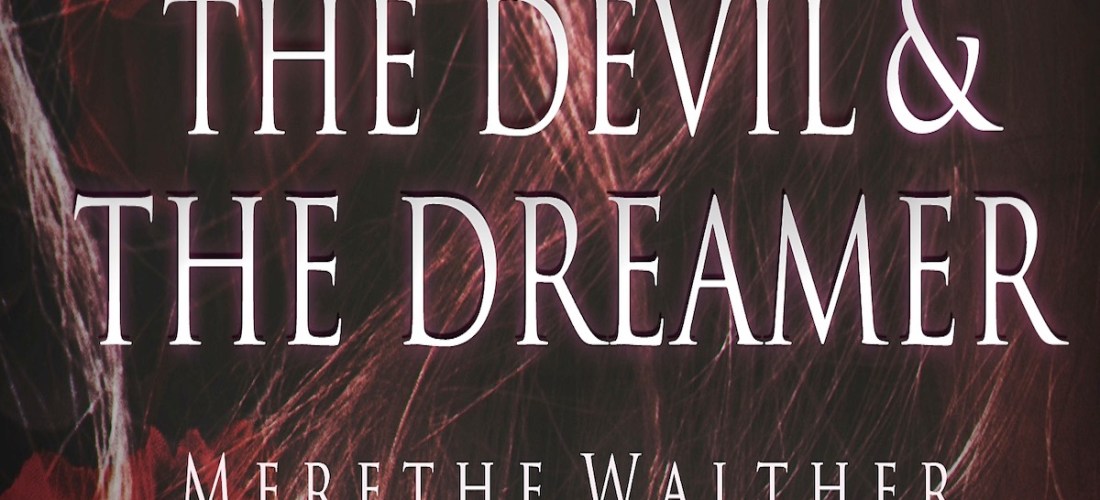
Book two, titled The Devil & the Dreamerwill be finished soon and should be available to order by the end of 2021 or the beginning of 2022, which means you won’t have to wait long at all. 

And lastly, I was incredibly proud to have earned a position as a semi-finalist in the Writers of the Future contest (first quarter of 2021) for one of my short stories. I got some truly inspiring advice on my work from David Farland, which was an incredible experience.

I hope everyone is staying safe out there! Keep an eye out for future reveals of book covers and release dates.

Capitalization: You’re Probably Doing It Wrong

Editor's Suggestions

One of the most common misconceptions that I run across in writing is when to capitalize things, and when they should stay lowercase. This is honestly a big issue, and can take your manuscript from potentially looking professional to seemingly amateurish in a heartbeat. It can be the difference between an agent or publishing house thinking that you know what you’re doing, or thinking that you started writing a week ago.

Proper capitalization in your writing is important for several reasons.

  • There are already pretty firm rules in place about this subject, so expressing ignorance of it means that you might also lack ignorance of other conventional writing rules.
  • If you Capitalize random words, It can make your Reader’s Voice messed up. Try reading This without doing a Weird version of Internal Puberty voice Changing in your Head. Can’t Do it, Can ya?
  • Capitalization is often used for emphasis or importance, but this is really, really, not the best use for it. It’s called “vanity capitalization,” and editors literally hate it. Capitalization should be kept to proper nouns (people’s names, place names, etc.), the first word in a sentence, and of course, proper titles.

One of the biggest no-no’s I’ve seen is confusing capitalization of honorifics. For some people, this can be a very difficult subject to broach, as there are many rules regarding the use of honorifics, and some of them are confusing.

What are honorifics? Honorifics are essentially “titles” that you give to people. Think sir, ma’am, mister, doctor, etc. For those of you writing medieval fiction, there are also the titles of royalty and lords. This can all get a bit confusing when you’re trying to figure out what needs to be capitalized, and what needs to be lowercase. So let’s start with some clarification!

When a title should or should not be capitalized:

First things first, NEVER capitalize “the” unless it’s the first word of your sentence or it’s the first word of your book/movie/art title.

“I saw The Secret Life of Pets the other day.” vs. “This is The Book of Shadows.” The second one is wrong. It will make your editor/agent/reader/publisher cringe. Don’t do it!

Sir & ma’am: Are only capitalized when they are the first word in a sentence.*

Correct:

Sir, I’ve got some bad news…”/ “But what were you hoping to hear, ma’am?”

Incorrect:

“I’ve got some bad news, Sir.” / “But what were you hoping to hear, Ma’am?”

* The only time this would be different is if you are introducing someone who’s been knighted, like Sir Elton John, or Sir Patrick Stewart. These are now titles that include the proper noun that makes them capitalized.

“Oh my goodness, it’s Sir Patrick Stewart! May I have your autograph, sir?”

“Eh, what do you know, mister?” vs. “That’s Mister Ford.”

“Can I ask you a question, miss?” vs. “I’m telling Miss Davis!”

Familial use

“But Mom said I could go.” vs. “That’s my mom.”

“Didn’t you ask your father?” vs. “Yes! And Father said I could go.”

“I’m going to see my uncle.” vs. “I’m going to see Uncle Robert.”

US political titles

“President” is a title frequently used in writing as a means of addressing the president. It also holds the first spot for one of the single most incorrectly capitalized terms I’ve ever seen. (And that’s not hyperbole, either.) You’ll notice in this paragraph that “president” is only capitalized at the beginning of a sentence.

(The following samples in this section are all correct.)

That’s because it’s not a proper noun on its own and therefore should not be capitalized unless before a name or if that’s someone’s actual name.

“But sir, the president is on her way now.” / “Tomorrow, President Adams will be speaking in the courtyard.”

The same goes for other political titles, like senator, congressman/woman, ambassador, vice president or chairperson, etc.*

“This is Robert Davies, the senator from Montana.” / “Excuse me, Senator Davies?”

“I’d like to introduce you to Congressman/woman Jones.” / “The congressman/woman isn’t available right now.”

*If your character is being addressed by a honorary title that includes the words “madame” or “mister,” etc. before it, then it is capitalized.

“Would Madame Ambassador follow me this way, please?” and “Mr./Mister Secretary, a word, if you can.” / “Please, Vice President Craig, listen to reason!” and “The vice president cannot take part in the meeting at this time.”

Titles of profession

Doctor, professor, officer, detective… these are all commonly capitalized when they should actually be lowercase. The only time these titles should be capitalized is when a proper noun follows them.

However, there are some grammar places that capitalize titles like “doctor” when they’re addressing the person by that title, though I personally do not follow these rules unless it’s a nickname, like calling your doctor “Doc.”

This is because doctor is both a profession as well as a title, and if you’re addressing someone as “doctor,” you’re calling them by their profession. It’s the same thing as saying “teacher” or “mailman.” None of these professional titles are typically capitalized unless adjoined to a proper name, like below.

“I’ve got a bad cold, doctor.” vs. “I’ve got a bad cold, Doctor Strauss.”

“I’ll have the paper to you tomorrow, professor.” vs. “I’ll have the paper to you tomorrow, Professor Adams.”

“That’s an order, captain!” vs. “That’s an order, Captain Walsh.”

“Over here, officer!” vs. “Over here, Officer Waterson!”

“Let’s get started, detective.” vs. “Let’s get started, Detective Peters.”

“But the teacher said we can’t.” vs. “But Teacher told me we can!” –You’ll note here that “teacher” is capitalized. That’s because it’s being used in place of a name of one specific person, and can be treated as a proper noun. If someone calls their teacher “Teacher” in place of her name, it can be treated as a proper noun of sorts.

Pet names

Nope. No capitalizing pet names. Nicknames, yes. Pet names? No.

“How are you doing, honey?” vs. “How are you doing, Nicky?”

Religious terms

There are too many to address, so I will leave a helpful link here.

Medieval titles/royal titles

One of the biggest problems I run across in fantasy is the improper use of titles. Basically they follow the same rules as the titles of profession, with a few exceptions, which will be addressed below. For the most part, when using a title like king, queen, prince, princess, duke, duchess, etc., do NOT capitalize unless it’s a direct address that includes their name.

“Introducing Queen Tabatha Shaw.” vs. “Introducing the queen, Tabatha Shaw.”

“That horse is the king’s!” vs. “That horse belongs to King Michael!”

“Protect the king!” vs. “Protect King Michael!”

“This is the duchess, Sarah Milford.” vs. “This is Duchess Sarah Milford.”

“Ah, Princess Anne, you’re looking lovely today.” vs. “Ah, princess, you’re looking lovely today.”

“No, my prince, the hunt has been canceled.” vs. “No, Prince Eric, the hunt has been canceled.”

“It is a pleasure to meet you, Lord Edward.” vs. “It is a pleasure to meet you, my lord.”

(“My lord” and “my lady” are only ever capitalized at the beginning of a sentence. Consider them the same as sir or ma’am.)

Medieval title exceptions

“What will you have me do, sire?” (Like sir, this word is not capitalized unless it’s the first of a sentence.)

“Today we’re going to the Lord Mayor’s joust!” (Lord Mayor is a capitalized term. However, if you were to say, “We’re going to the mayor’s joust,” it would be lowercase. “We’re going to Mayor Johnson’s joust.”)

His Grace Duke Edward Gibbs.” vs. “How do you do, your grace?”

“But Your Majesty, we must adjourn.” vs. “But majesty, I must protest…”

“Oh, Your Excellency, of course!” vs. “Oh, of course, excellency.

“Yes, Your Highness, we will have it done right away.” vs. “No, highness, we didn’t.”

These cover a few common (and easy to confuse) terms that should either be capitalized or lowercased given their use in the sentence.

And remember, when in doubt, find out if there is a name after the title or honorific, and choose accordingly.

Photo: weheartit
Think You Couldn’t Possibly Lose Your Amazon Publishing Account? Think Again.

Blog Articles

VERY Important information about authors on Kindle Unlimited through Amazon

Becca's avatarThe Active Voice

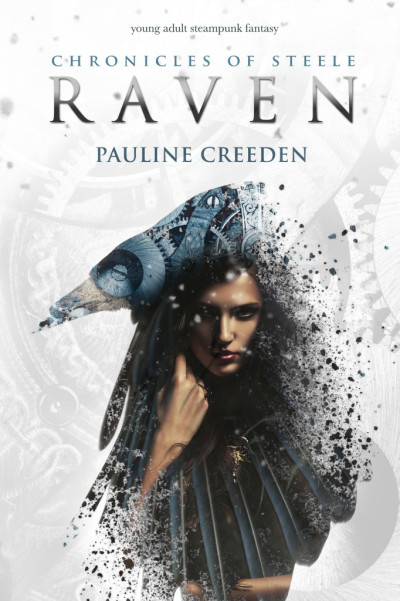
There’s this indie author I know a little bit from the Kboards.com forum. Her name is Pauline Creeden, and she’s an ordinary midlister, like so many of us. I remember PMing her some time ago and gushing about how particularly beautiful one of her book covers is — the one for Chronicles of Steele: Raven.collection Here, I’ll include an image. Gorgeous, eh?
Anyway, today I tuned in to Kboards and noticed that Pauline had started a thread. It contained what’s surely the worst news possible for an indie author: Amazon had closed her publishing account. All her ebooks had been taken off sale. Permanently. Here’s the email she got from Amazon:

We are reaching out to you because we have detected that borrows for your books are originating from systematically generated accounts. While we support the legitimate efforts of our publishers to promote their books, attempting to manipulate…

View original post 1,085 more words

Just. One. Book.

Blog Articles

Help them out!

Margaret Elysia Garcia's avatarThrowing Chanclas

Just. One. Book.

I live in a town of 1200 people in the Northern Sierra Nevada –where it meets the Cascade Range near Mt. Lassen National Park and about two hours drive northwest of Reno, NV.  Two hundred of that population is students. Over the years as the population dwindled after mines closed, then mills–nothing except tourism and retirement have emerged as ‘industries.’ Many businesses have closed down and with it many things we take for granted—like libraries.

The local junior/senior high school has not been able to purchase new books since the 90s. Some of the “check outs” for old books are in the 1980s. There are no books by people of color in the library. Hardly any books by women are in the few book cases except your standard Austen and Lee. It’s an uninviting place. There hasn’t been a librarian for nearly a decade. And volunteers weren’t allowed. The…

View original post 672 more words

Talk that Talk (the Way Your Reader Likes it!)

Editor's Suggestions

Today, Inklings, we’re talking about talking.

Naturalizing your dialogue, to be specific.

Every writer has their own unique voice when they’re writing, because every person has their own dialect, inflections, voice patterns, and even vocabulary or colloquialisms. This is part of what makes language so diverse and gratifying to play with. You can use a variety of letters and sounds, and even make up your own!

But despite this, many writers struggle when it comes to making their characters speak, and if you have this problem, trust me, you are not alone. Dialogue between imaginary characters is hard, dude.

There are books upon books and blogs and lessons and classes and conferences about creating awesome dialogue, but there is a much, much simpler method of amping your character’s convos up to enjoyable levels.

1. Listen to conversations around you.

Go to your local coffee shop, grocery store, park. Sit for a while and hear how people speak. Pay attention to how they phrase things, or what inflection they use. Are they guilty of “up talk” or “vocal fry?” Do they over use the word “like” or “uhm” or “you know” because they are struggling to piece their words together? Do they have a tic, like beginning every sentence with “Okay, so…”, or just jump in and talksofastyoucan’tevencatchup? Believe it or not, these are all things you can incorporate (within reason) in your own writing. To make dialogue in writing believable, you have to know speaking in real life. You have to understand speech patterns—but this isn’t as hard as it sounds.

As human beings, we are actually significantly gifted at picking up body language and tone in speech, and now, it’s your great difficulty to translate that innate knowledge into your book.

2. USE. CONTRACTIONS.

As I’ve stated many times before, one of the easiest ways to make your language flow is an extraordinarily simple one. When you’re talking to a family member, do you say everything so prim and proper that you could be an extra in Pride and Prejudice? Chances are, no, no you don’t. Everyone has their “professional” voice and their “relaxed” voice. Professional you might be more precise, but chances are you won’t be able to cut those syllables with a chisel, right? Relaxed voice is how you normally speak, when you’re alone or with comfortable acquaintances. Putting a sense of “relaxed” voice in dialogue is a fantastic way of making your reader “say” it in their own version of relaxed voice, which makes it flow smooth like butta, baby. And the best way to do this? Use contractions.

“Do not take that bag out of the closet! If I have to look for it, I will end up late to practice!”

“Jer, we are going to the store. Is there anything you will need me to pick up?”

“I cannot forget to put all of the laundry in the dryer when I get home.”

“But Barbara, there is nothing you can do. He told you he does not want any help.”

Or

“Don’t take my gym bag out of the closet! If I’m late to practice because it’s missing, I’ll be pissed!”

“Jer, we’re going shopping. You need anythin’?”

“Aww, crap! I gotta remember to switch the laundry over when I get back.”

“Barb, you can’t do anything. He said he doesn’t want help.”

Write how people speak, not how a narrator would dictate a sentence.

3. Read EVERYTHING aloud. ALL OF IT.

Go and read a portion of a book out loud. Doesn’t have to be dialogue or even your own work; just pick something and go. Did you find yourself sliding over the pronunciation of certain letters in favor of your relaxed voice? Like saying ‘don’ instead of don’t? Do you perhaps soften your “r” to the point where ya sound Bostonian? Did you read it fast, or slow? Did it jive with your internal voice, or did you find yourself pausing and rereading portions so you could reassess the tone? Reading written words aloud will strengthen your understanding of dialogue and language in general. Pay attention to your own accent. Are you from the south? Did you know that southern accents have different dialects depending on where you live? Midwestern tones can seem southern, but have subtle differences, and west coast people sound completely different from northerners and southerners altogether? A Bostonian accent is drastically different than one in New York, and both are distinguishable from New Jersey or New England.

Hearing words out loud from different regions can really help you develop a style of writing conversations that will give everyone an individual voice. If you want your characters to pop, give them different “vocal” affectations. Learn to recognize and incorporate different accents, dialects, and parts of speech in your dialogue to give your character, well… character.

4. Use slang and colorful (not necessarily vulgar) language.

My siblings and I grew up in northern Florida surrounded by country folk and surfer dudes, but my mother is from New York, so we picked up a lot of slang from her that wasn’t common in that area. I ended up pronouncing forest as “fah-rest” or orange as “ah-renge”, and we abbreviated “shut up” so that it became a single word (“shaddup!”) and we called unidentified bits of paper or fluff on the floor “schnibbles.” At the same time, I was developing a touch of a lazy drawl, and getting a bit too relaxed around g’s, if you know what I’m sayin’. I was comfortable with “surfer talk”—which is its own thing entirely. I found out that I would specify tacos at Taco Bell the southern way of “the 89 cent” ones—yes, children, tacos did used to be that cheap. We don’t lie when we say the 90s were a wonderful time—or when telling someone to leave “something” alone, I would often jam the words together to pronounce it as “Lea’ that alone.” I fought against using “ain’t,” although I will admit that it has slipped in conversation at least twice. Language is fun! Use various methods to make yours enticing.

5. If it doesn’t need it, DON’T MAKE THEM TALK.

Sometimes, the best things are left unsaid, right? Well, occasionally. In dialogue, “a picture is worth 1000 words” takes on extra meaning. If you can show us what’s going on without your characters talking us through it, then do it. When you’re writing a screenplay, dialogue is a precious commodity. You seriously have to consider what words are going on that page because you are so limited with page space. Some of my favorite parts of a movie are where the characters say absolutely nothing because the action speaks so well for them. If your character is talking when they really should be quiet, remove it. See how well silence can direct a scene for you.

Pixar actually does a fantastic job nixing dialogue in favor of showing action—think of the beginning of the movie Up, or actually don’t, because I do not need to cry right now. How about a film like Wall-E, instead? The action carried so well that they were able to forego dialogue in HUGE portions of the film, and one of the sweetest moments ever is when Wall-E first meets Eve:

Now imagine if he had been giving her verbose, expository dialogue about how he’d been fulfilling his mission to box all the trash on Earth.

When in doubt, go without!


photo: SFStation

3 Cliches (That Completely Lose Your Reader)

Editor's Suggestions

The Top 3 Clichés that Make Me Close a Book

By Kelly Kobayashi

1. The Love Triangle

How many times have you yourself been in a Love Triangle? How many times has anyone you’ve ever known? I’m sure I’m blowing your mind when I tell you honestly that neither is true from my own experience. Have I known girls who broke up with one guy because they found themselves attracted to someone new? Definitely. Have I known guys who stayed silent and sat on their feelings until they sorted out which girl of two to approach? Of course.

But I’ve never personally known anyone just so darn alluring that multiple people crushed on them (and made their passionate feelings known) at once. I’ve never found myself so confused by my own feelings as to selfishly string anyone along. I’ve never known any boy, girl, man, or woman so stupid as to not know the difference between “I find this person hot” and “I care for this person’s story, their happiness, opinions, feelings, and overall well being.” Lust and Love are not hard to separate, even for teenagers. Shocking, I know.

So, even more offensive to me than the predictability, pointlessness, and utter failure at creating tension, is that the Love Triangle is just unrealistic. It’s lazy. And it’s actually pretty insulting, especially to YA readers. We know who we would pick, so why is the protagonist such a shallow, cruel, weak dimwit?

ezgif.com-resize-3
giphy

Don’t care. *slams book shut*

2. The Misunderstanding That Could Be Solved With a Single Conversation

Usually goes something like this: Girl sees Boyfriend walking beside another girl across the street. (They are not even holding hands.) Next day, Girl freezes Boyfriend out. No texts, no calls, no explanation.

Girl, I don’t have time for you and your faux drama. Boyfriend is really better off without you if that’s the way you’re going to act.

Or how about this: Male Lead of high fantasy novel finds out his Female Lead is stuck in an unwanted-but-arranged marriage, which—due to obvious factors such as time period, societal norms, and family politics—is completely understandable, but he still accuses Female Lead of betrayal, cowardice, and gold-digging.

Um, Author, you set up this world. You designed it as a medieval realm. You created gender parameters around the Female Lead. You made arranged marriages an accepted practice. Why is your Male Lead throwing 2016 shade?

large.gif
weheartit

Nope. *slams book shut*

3. The Misdirected Insta-Thirst for Revenge

Ugh. This one I really just can’t take seriously. And it’s the crux of far too many crime thrillers and graphic novels. This one plays out: Villain murders Mentor, Love Interest, or Family Member, then leaves scene. Best friend enters scene. Hero walks in, merely sees Best Friend standing over the body (wearing a look of horror), and vows REVENGE! upon them.

Call me nitpicky, but I’m pretty sure I would want to… you know, ask questions, investigate, and FIND THE REAL VILLAIN who is not my OBVIOUSLY-A-GOOD-GUY Best Friend?! I would at least ask Best Friend what happened. Did they see anyone? Did they just get there like I did? Have they already called for an ambulance?

If the Hero’s friendship is so tissue-paper-thin that he can believe Best Friend capable of murder, I don’t care if he realizes the truth later. Best Friend should run in the opposite direction from this idiot’s brand of loyalty and consideration.

giphy1.gif
giphy

I can’t even. *slams book closed*


Feat. Photo: mensxp

How Social Media Screws Your Book Review

Blog Articles

Amazon comes under fire a lot, it seems, for its treatment of authors in general: They delete books and then later apologize but still don’t put them back in a timely manner. They have let reviewers who admitted to not reading a book keep their reviews up, or “trolls” to punish an author by putting up one-star reviews—this got so out of hand at one point that famed author Anne Rice had to step in and make news by signing a petition for Amazon to better protect its authors. And most recently, Amazon has cracked down on reviews by refusing to let friends or family members post them—even when those reviews are fair and unbiased—simply because they know of a connection between the author and the reviewer.

In this day and age, being an Amazon “author” is one of the easiest things to do. Literally. Anyone can sign up for an account and post their book, letting it drift off to become one more piece of literary flotsam ebbing along on the shores of the great, wide web.

What’s hard though, is marketing your books—and yourself—and that requires a network of people around you who are willing to vouch for your authenticity as a writer. i.e., you need friends and family members willing to go to bat for you. Authors you’ve worked with or schmoozed at conventions. People on Facebook that you barely know except by random waterfalling “friend of a friend” connections, who surprised you by accepting your request for reads and reviews.

So why is Amazon punishing these reviewers?

The history of Amazon’s book review process is a pretty storied one (bah-dum-tssh!), and goes back many embattled author complaints into the past. One notable instance was in 2012, when a group that called themselves “No Sock Puppets Here Please” (NSPHP) found that some authors were boosting their books with “sock puppet” accounts—fake accounts they made for the sole purpose of reviewing their own work. There were even authors who admitted to paying for reviews, like Todd Rutherford, who eventually anted up to over 300 paid reviews.

NSPHP created a petition to stop the sock puppets, and Amazon listened and took what they said to heart, deleting thousands of reviews from people who even might have possibly known the author or were also authors themselves.

Wait, what?

That’s right. Amazon started deleting book reviews from other authors because they “might have been colleagues.”

As J.A. Konrath said in regards to the signers of the NSPHP petition, “You have killed an annoying mosquito using a nuclear weapon, collateral damage be damned.” Sure, some sock puppet accounts were deleted, but overall, it was well-intentioned, honest reviews that mostly took the hit.

Ouch.

Since then, Amazon frequently tries to police its own forums and reviews, making an attempt to not let authors use sock puppet accounts.

Okay, I’m with you on that, that’s good.

But this can get a little out of hand from time to time, when people who know the author and have read the book are suddenly stripped of their ability to write an honest review. In the author groups and forums I frequent, I see people complaining because fellow authors in their same circles have had reviews deleted because they’re “colleagues.” People who post openly and honestly in the comment about their relationship to the author—whether it’s personal, like a friendship, or professional, like a fellow writer—are getting the same treatment: the axe.

review

Amazon is a great site, and it has done wonders for getting authors to reach audiences with their books. The Kindle is king of ebooks, and as of 2014, 19.5% of all books sold in the U.S. were Amazon Kindle titles.

But sometimes their intuition isn’t so… intuitive. Case and point with authors getting reviews deleted or refused by people who “know them” because Amazon wants to avoid angering the NSPHP denizens again. So they’ve effectively made themselves scared natives sacrificing their sheep and prettiest virgins to the volcano god to appease its rumbling, even though it hasn’t rumbled in years. NSPHP doesn’t even exist anymore.

There must absolutely be a policy in place to protect both the author and the consumer, but someone who knows and (probably) likes you who goes and reads your book and wants to leave a review is not the same as an author creating a sock puppet account or paying people to review the book or flood it with undeserved praise in order to up the rating. Amazon needs to learn to differentiate between the two, and cull the numbers in a better fashion rather than going full scorched-earth.

Is there anything you can do to protect yourself as an author? Yes, a little, but it’s not guaranteed. Amazon can still delete reviews whenever they feel like it, based on whatever hoodoo rules they’ve recently started developing. Check your social media sites and know what apps have permission to view your information. Goodreads, which is owned by Amazon (along with these other companies) can share your info if you’re logged into them with your Facebook account. That means Goodreads knows who’s on your friends list and can tell on you like a digital version of Gríma Wormtongue whispering in King Amazon’s ear. Make your friends’ list on Facebook private, make certain you’re not sharing app information with Amazon or Goodreads (or any other company Amazon owns), and make certain you don’t connect your Facebook account to Goodreads if it’s connected to your Amazon author account.

Jeez, that’s a lot of work!

I know, I know. It’s a rabbit hole, and you’re poor Alice, falling forever and wondering what you did to deserve this. Eventually, another site will start to rival Amazon on book sales, or Amazon will wise up and start thinking realistically about the realization of deleting the comments on a new author’s books because they were done by the only people the fledgling author knew and could comfortably ask to review them.

Maybe that will happen soon, but until then, learn how you can protect yourself from getting your reviews deleted, and be wise with your social media sharing.

Photo: weheartit


Yangon, Myanmar

Real Editing Samples

This week’s short story comes to us anonymously! Below is the review of the untitled piece, as well as some suggestions for how to make it even better. Any suggestions or questions can be put in the comments section below.

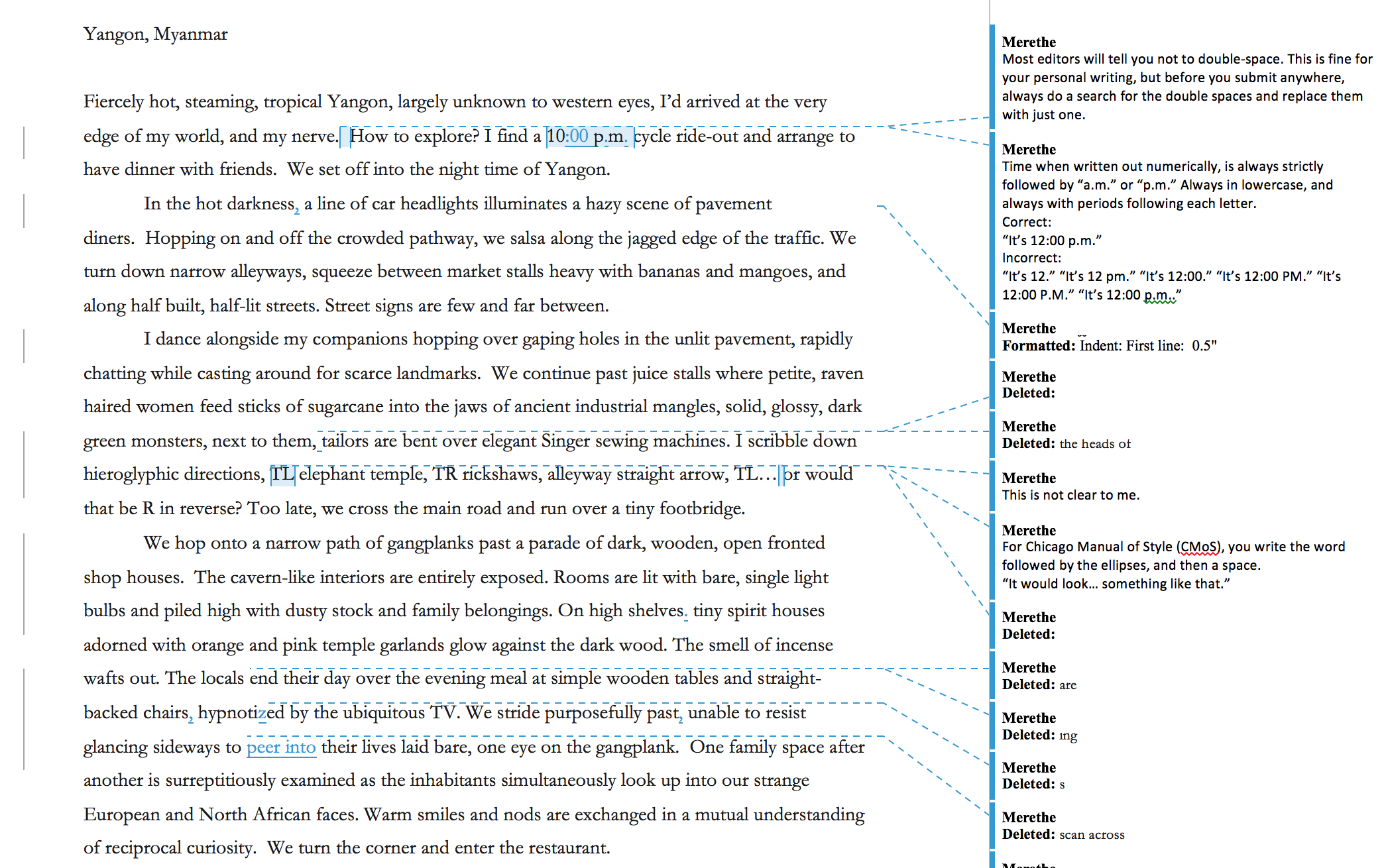
Screenshot 2016-03-28 17.43.43.png

One of the very first things you want your reader to do is be intrigued. You have to really pull someone in within the first few paragraphs so that they have a reason to keep reading. That means you’re going to need to give your reader one of two things: Action, or mystery.

Action and mystery are great openers; they will pull your reader in. But it will do absolutely nothing if there isn’t anything interesting for us to find out. If your character is going through a series of nonsensical  movements (to your reader, at least), and we don’t know why, that’s not mystery, it’s just confusion.

You have a beautiful set up here: “Fiercely hot, steaming, tropical Yangnon, largely unknown to western eyes.” But that isn’t followed through with anything. It immediately gets dismissed by the next sentence. “How to explore? I find a 10:00 p.m. cycle ride-out and arrange to have dinner with friends.”

How to strengthen your opening? Remove the weak area.

How to explore? I find a 10:00 p.m. cycle ride-out and arrange to have dinner with friends.  We set off into the night time of Yangon.

“Fiercely hot, steaming, tropical Yangon, largely unknown to western eyes, I’d arrived at the very edge of my world, and my nerve.  In the hot darkness, a line of car headlights illuminates a hazy scene of pavement diners.  Hopping on and off the crowded pathway, we salsa along the jagged edge of the traffic. We turn down narrow alleyways, squeeze between market stalls heavy with bananas and mangoes, and along half built, half-lit streets. Street signs are few and far between.”

Already this is building a world for me. I can imagine it, I can smell the mangoes, I can see the people. That’s great! That will pull your reader in. Where are they going? What are they doing in this tropical paradise? I want to know more!

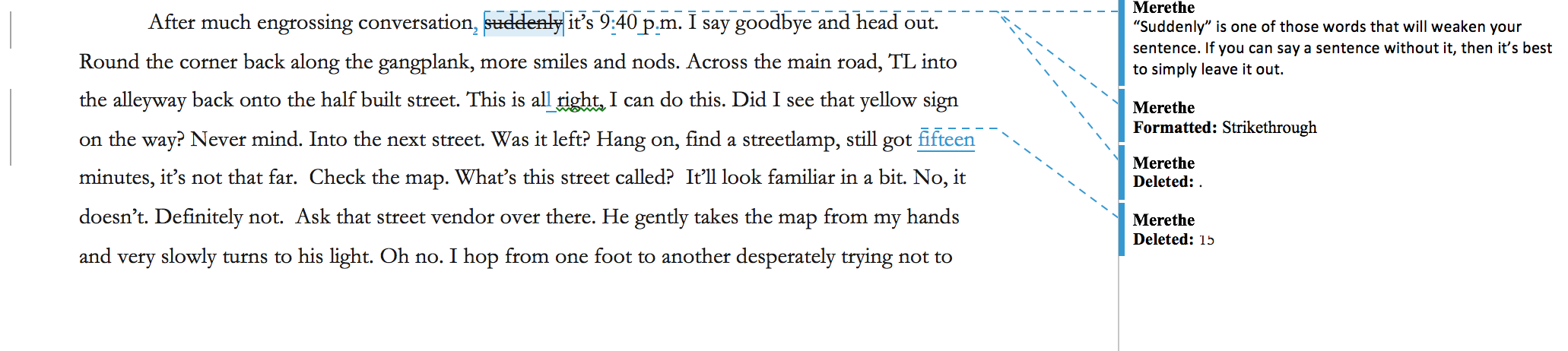
Screenshot 2016-03-28 17.43.58.png

Screenshot 2016-03-28 17.44.30.png

Notes 2. In the paragraph following the beautifully described world, you have your character somewhat frantically going to find directions. This pulled me out of the story. Apart from showing their state of mind, and letting us know that there’s somewhere they need to be, which could be summarized neatly in a few sentences at the start of the following paragraph, this particular paragraph doesn’t do anything for your reader. In a short story, you’ll have less time to pull your reader in. This paragraph could easily be shortened and joined with the following one, or removed and summarized in fewer sentences.

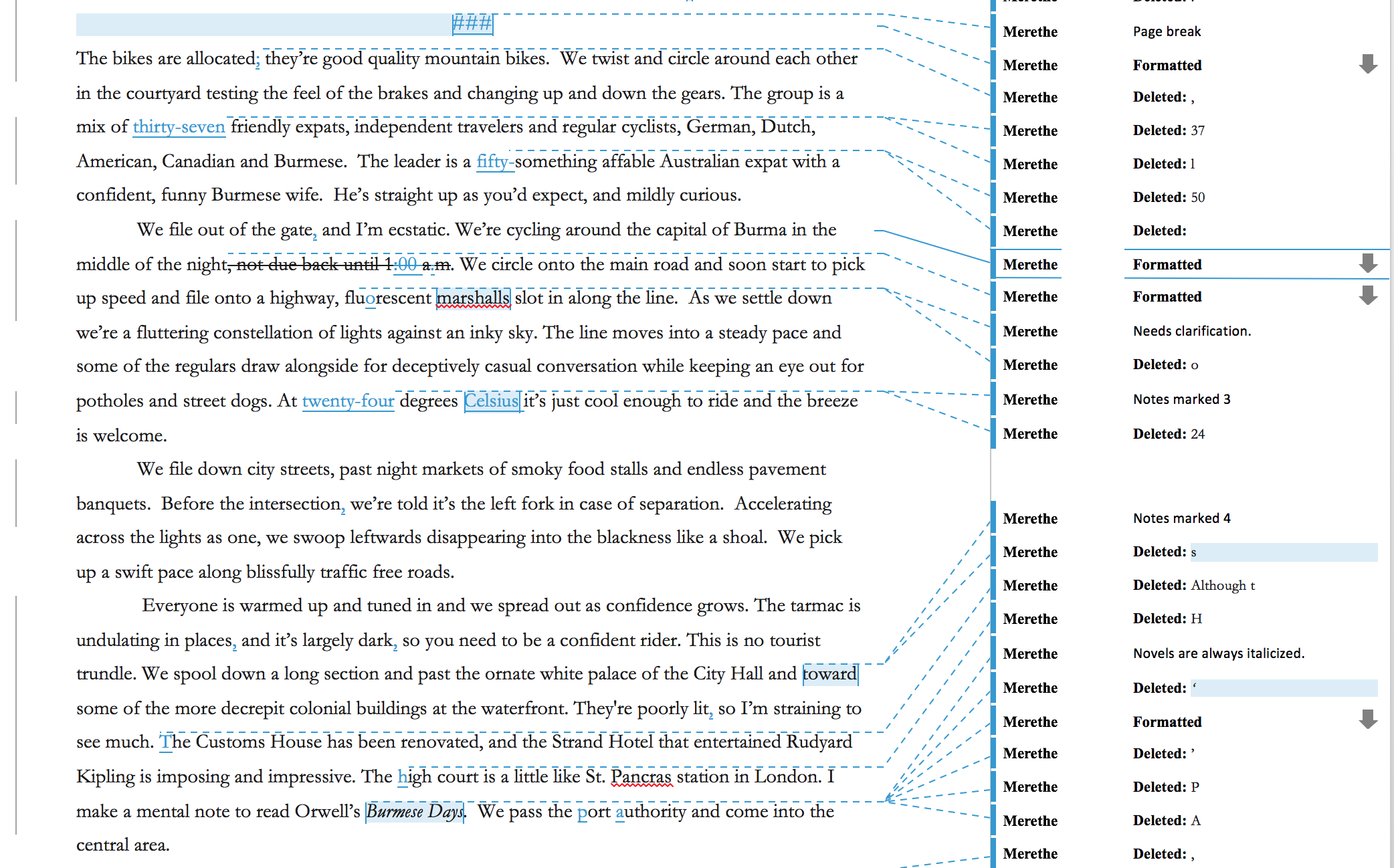
Screenshot 2016-03-28 18.17.54.pngNotes 3. You definitely want to specify to your readers about anything related to temperature. Given that we Americans can’t figure out degrees in Celsius to save our hides, we instinctually fall back on the Fahrenheit degree base, and twenty-four degrees in Fahrenheit does not a pleasant bike ride make! If your readers might be from various parts of the English-speaking world, make sure to specify things like this just so they don’t have to double take to figure out what you mean.

Notes 4. For British/UK English, the standard is to keep the ‘s’ at the end. (Towards/backwards) This is simply a matter of where you intend for your main audience to be. Again, if this is elsewhere in the English-speaking world outside of America, this would probably stay in. To publish in America, however, the ‘s’ would be taken out (toward/backward). Small differences, but they can add up. The same can be said with any s to z changes. In America: organize, realize, recognize, etc. Outside of America: organise, realise, recognise. And of course we Americans also remove the ‘u’ from words like colour.

Overall, I thoroughly enjoyed the short story!  You got a lot of detail and description in for such a small amount of pages. You definitely have a strength in creating a vivid landscape. I could see the story. I could picture what was going on. Your imagery was beautiful and strong, and really pushed me through it. There was a great flow to the way you described everything. There is a little to be corrected as far a pace goes, like with the part that stalled me, but overall, it was a fun read.

I wanted to mention, as well, that after having read this story, that I have no idea what your character looks like, if they’re male or female, or even what they’re wearing. I kind of argued with myself about even mentioning it, because I honestly can’t tell if I like it more without the protagonist having an identity. It did nag at me a little, but then, it’s my job to notice things like that.

Thanks so much, Anonymous Inkling, for letting me read and critique your short story! I will be sending along the rest of my critiques later on. For those of you who want to read the full piece, you can find it here:

Yangon, Myanmar

Fiercely hot, steaming, tropical Yangon, largely unknown to western eyes, I’d arrived at the very edge of my world, and my nerve. In the hot darkness, a line of car headlights illuminates a hazy scene of pavement diners.  Hopping on and off the crowded pathway, we salsa along the jagged edge of the traffic. We turn down narrow alleyways, squeeze between market stalls heavy with bananas and mangoes, and along half built, half-lit streets. Street signs are few and far between.

I dance alongside my companions hopping over gaping holes in the unlit pavement, rapidly chatting while casting around for scarce landmarks.  We continue past juice stalls where petite, raven haired women feed sticks of sugarcane into the jaws of ancient industrial mangles, solid, glossy, dark green monsters, next to them, tailors are bent over elegant Singer sewing machines. I scribble down hieroglyphic directions, TL elephant temple, TR rickshaws, alleyway straight arrow, TL… or would that be R in reverse? Too late, we cross the main road and run over a tiny footbridge.

We hop onto a narrow path of gangplanks past a parade of dark, wooden, open fronted shop houses.  The cavern-like interiors are entirely exposed. Rooms are lit with bare, single light bulbs and piled high with dusty stock and family belongings. On high shelves. tiny spirit houses adorned with orange and pink temple garlands glow against the dark wood. The smell of incense wafts out. The locals end their day over the evening meal at simple wooden tables and straight-backed chairs, hypnotized by the ubiquitous TV. We stride purposefully past, unable to resist glancing sideways to peer into their lives laid bare, one eye on the gangplank.  One family space after another is surreptitiously examined as the inhabitants simultaneously look up into our strange European and North African faces. Warm smiles and nods are exchanged in a mutual understanding of reciprocal curiosity.  We turn the corner and enter the restaurant.

After much engrossing conversation, suddenly it’s 9:40 p.m. I say goodbye and head out. Round the corner back along the gangplank, more smiles and nods. Across the main road, TL into the alleyway back onto the half built street. This is all right, I can do this. Did I see that yellow sign on the way? Never mind. Into the next street. Was it left? Hang on, find a streetlamp, still got fifteen minutes, it’s not that far.  Check the map. What’s this street called?  It’ll look familiar in a bit. No, it doesn’t. Definitely not.  Ask that street vendor over there. He gently takes the map from my hands and very slowly turns to his light. Oh no. I hop from one foot to another desperately trying not to be impolite. This street? This way? Yes?  Twelve minutes. Right, I’ll get there. Just dance around people and traffic a bit faster.  Okay, this is it. Go. Got to get there, don’t want to keep them waiting, once in a lifetime experience. Why didn’t I leave earlier?  Getting closer now, it’s round this next corner and up past the Swiss Embassy. Just need to jog a bit now. I wonder if that’s where that car’s going? Probably.  Yes, there’s the sign, Bike Rides, Yangon. It’s 9:59 p.m.

###

The bikes are allocated; they’re good quality mountain bikes.  We twist and circle around each other in the courtyard testing the feel of the brakes and changing up and down the gears. The group is a mix of thirty-seven friendly expats, independent travelers and regular cyclists, German, Dutch, American, Canadian and Burmese.  The leader is a fifty-something affable Australian expat with a confident, funny Burmese wife.  He’s straight up as you’d expect, and mildly curious.

We file out of the gate, and I’m ecstatic. We’re cycling around the capital of Burma in the middle of the night, not due back until 1:00 a.m. We circle onto the main road and soon start to pick up speed and file onto a highway, fluorescent marshalls slot in along the line.  As we settle down we’re a fluttering constellation of lights against an inky sky. The line moves into a steady pace and some of the regulars draw alongside for deceptively casual conversation while keeping an eye out for potholes and street dogs. At twenty-four degrees Celsius it’s just cool enough to ride and the breeze is welcome.

We file down city streets, past night markets of smoky food stalls and endless pavement banquets.  Before the intersection, we’re told it’s the left fork in case of separation.  Accelerating across the lights as one, we swoop leftwards disappearing into the blackness like a shoal.  We pick up a swift pace along blissfully traffic free roads.

Everyone is warmed up and tuned in and we spread out as confidence grows. The tarmac is undulating in places, and it’s largely dark, so you need to be a confident rider. This is no tourist trundle. We spool down a long section and past the ornate white palace of the City Hall and toward some of the more decrepit colonial buildings at the waterfront. They’re poorly lit, so I’m straining to see much. The Customs House has been renovated, and the Strand Hotel that entertained Rudyard Kipling is imposing and impressive. The high court is a little like St. Pancras station in London. I make a mental note to read Orwell’s Burmese Days.  We pass the port authority and come into the central area.

I’ve teamed up with a Canadian who peels away from the line. I follow instantly and we head towards the 2,500-year-old Sule Pagoda, in the middle of what is now a huge roundabout.  Its endless golden spire punctures the dark velvet sky. The white dome is encircled by grotto-like shrines, their interiors brightly lit in citrus limes and lemons. It’s a fairy tale, fairground sight. We swoop onto the curve and spin around the outside, stealing glimpses at the golden Buddha’s heads surrounded by multi-colored sunbursts of flashing neon lights.  We sprint round a second time, faster, leaning into the road, laughing with glee and exhilaration at this fantastical, surreal merry-go-round, and race off to catch the others.

The group is on the road out of the city now and we begin a gentle climb, I start to feel my thigh muscles burn. It’s about 11: 30 p.m. The pace slows a little, but is still good as we reach the flat and start the long home stretch. Soon the leaders stop and the line concertinas into a tight group. We climb off the bikes to stretch our legs and gulp down some much needed water.

People chat and examine each others’ bikes. As my heart rate and breathing slows I look up at the night sky and feel the tranquility and eeriness of a strange city at rest. The quiet chatter of the other riders floats through the darkness. Then for no reason at all, I turn round. There, in the middle of an enormous jet black sky, gently glowing like a huge mythical, golden palace is the Schwedagon Pagoda, the most sacred Buddhist Pagoda in Myanmar. It stands on a hill and at 325 feet, dominates the Yangon skyline. It contains the oldest Buddhist Stupa in the world. I’m rooted to the spot. I look at my watch, it’s past midnight. I feel giddy with awe and surprise.


Photo: A Link And Travel Tour