3 Cliches (That Completely Lose Your Reader)

Editor's Suggestions

The Top 3 Clichés that Make Me Close a Book

By Kelly Kobayashi

1. The Love Triangle

How many times have you yourself been in a Love Triangle? How many times has anyone you’ve ever known? I’m sure I’m blowing your mind when I tell you honestly that neither is true from my own experience. Have I known girls who broke up with one guy because they found themselves attracted to someone new? Definitely. Have I known guys who stayed silent and sat on their feelings until they sorted out which girl of two to approach? Of course.

But I’ve never personally known anyone just so darn alluring that multiple people crushed on them (and made their passionate feelings known) at once. I’ve never found myself so confused by my own feelings as to selfishly string anyone along. I’ve never known any boy, girl, man, or woman so stupid as to not know the difference between “I find this person hot” and “I care for this person’s story, their happiness, opinions, feelings, and overall well being.” Lust and Love are not hard to separate, even for teenagers. Shocking, I know.

So, even more offensive to me than the predictability, pointlessness, and utter failure at creating tension, is that the Love Triangle is just unrealistic. It’s lazy. And it’s actually pretty insulting, especially to YA readers. We know who we would pick, so why is the protagonist such a shallow, cruel, weak dimwit?

ezgif.com-resize-3
giphy

Don’t care. *slams book shut*

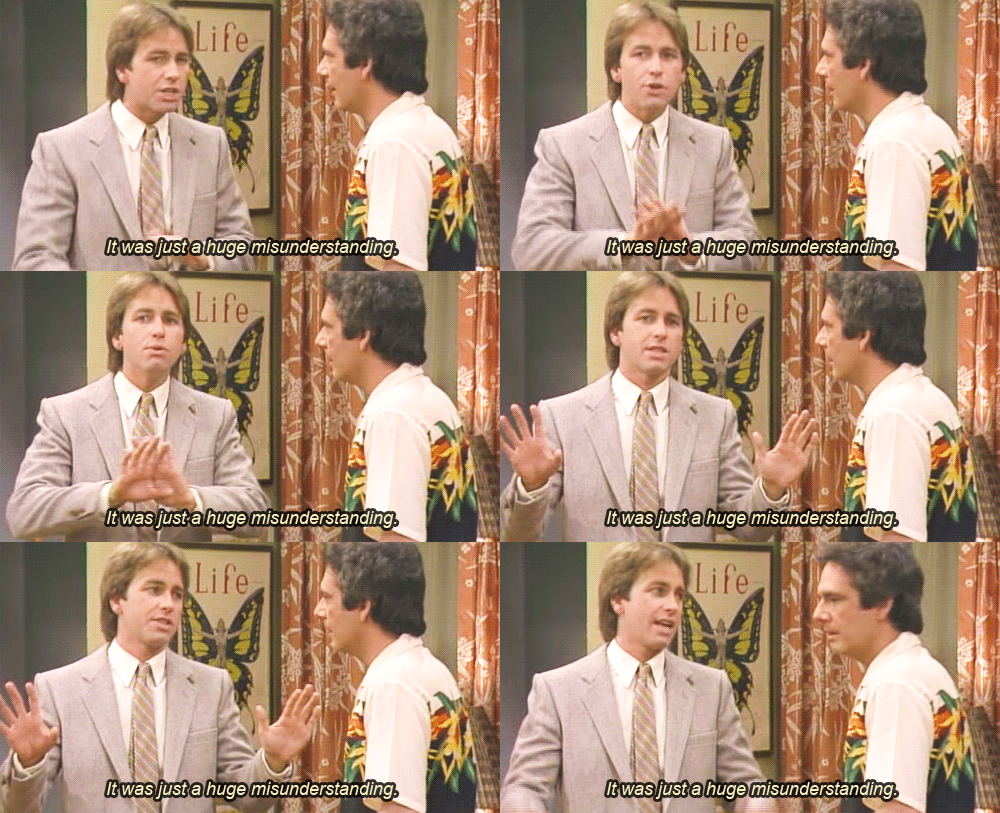
2. The Misunderstanding That Could Be Solved With a Single Conversation

Usually goes something like this: Girl sees Boyfriend walking beside another girl across the street. (They are not even holding hands.) Next day, Girl freezes Boyfriend out. No texts, no calls, no explanation.

Girl, I don’t have time for you and your faux drama. Boyfriend is really better off without you if that’s the way you’re going to act.

Or how about this: Male Lead of high fantasy novel finds out his Female Lead is stuck in an unwanted-but-arranged marriage, which—due to obvious factors such as time period, societal norms, and family politics—is completely understandable, but he still accuses Female Lead of betrayal, cowardice, and gold-digging.

Um, Author, you set up this world. You designed it as a medieval realm. You created gender parameters around the Female Lead. You made arranged marriages an accepted practice. Why is your Male Lead throwing 2016 shade?
large.gif
weheartit

Nope. *slams book shut*

3. The Misdirected Insta-Thirst for Revenge

Ugh. This one I really just can’t take seriously. And it’s the crux of far too many crime thrillers and graphic novels. This one plays out: Villain murders Mentor, Love Interest, or Family Member, then leaves scene. Best friend enters scene. Hero walks in, merely sees Best Friend standing over the body (wearing a look of horror), and vows REVENGE! upon them.

Call me nitpicky, but I’m pretty sure I would want to… you know, ask questions, investigate, and FIND THE REAL VILLAIN who is not my OBVIOUSLY-A-GOOD-GUY Best Friend?! I would at least ask Best Friend what happened. Did they see anyone? Did they just get there like I did? Have they already called for an ambulance?

If the Hero’s friendship is so tissue-paper-thin that he can believe Best Friend capable of murder, I don’t care if he realizes the truth later. Best Friend should run in the opposite direction from this idiot’s brand of loyalty and consideration.
giphy1.gif
giphy

I can’t even. *slams book closed*


Feat. Photo: mensxp

The Life Cycle of the Great American Novel

Uncategorized

katemillermd's avatarKate Miller, M.D.

Or, How Hemingway Became an Alcoholic


When people find out my debut novel is being released this month, one of the first questions they ask is how long it takes to write a novel and get it published. I tell them Karma Patrol took two and a half years from the first word to the paperback copy, and I’m always met with astonishment.

“What takes so long?” they ask, eyes wide. “Don’t you just write it and then someone prints it?”

And I smile as I reach for my wine glass.

For you, dear reader, I have compiled a monthly timeline of Karma Patrol’s life, from the moment the idea came to me until the release of the paperback. You may want to have a sympathy glass of wine on hand.


12718014_483826951818683_4763307751926848404_nOctober 2013: Lightning strikes! Concept for Karma Patrol is born.

November 2013: National Novel Writing Month. Between November 1

View original post 1,188 more words

How Social Media Screws Your Book Review

Blog Articles

Amazon comes under fire a lot, it seems, for its treatment of authors in general: They delete books and then later apologize but still don’t put them back in a timely manner. They have let reviewers who admitted to not reading a book keep their reviews up, or “trolls” to punish an author by putting up one-star reviews—this got so out of hand at one point that famed author Anne Rice had to step in and make news by signing a petition for Amazon to better protect its authors. And most recently, Amazon has cracked down on reviews by refusing to let friends or family members post them—even when those reviews are fair and unbiased—simply because they know of a connection between the author and the reviewer.

In this day and age, being an Amazon “author” is one of the easiest things to do. Literally. Anyone can sign up for an account and post their book, letting it drift off to become one more piece of literary flotsam ebbing along on the shores of the great, wide web.

What’s hard though, is marketing your books—and yourself—and that requires a network of people around you who are willing to vouch for your authenticity as a writer. i.e., you need friends and family members willing to go to bat for you. Authors you’ve worked with or schmoozed at conventions. People on Facebook that you barely know except by random waterfalling “friend of a friend” connections, who surprised you by accepting your request for reads and reviews.

So why is Amazon punishing these reviewers?

The history of Amazon’s book review process is a pretty storied one (bah-dum-tssh!), and goes back many embattled author complaints into the past. One notable instance was in 2012, when a group that called themselves “No Sock Puppets Here Please” (NSPHP) found that some authors were boosting their books with “sock puppet” accounts—fake accounts they made for the sole purpose of reviewing their own work. There were even authors who admitted to paying for reviews, like Todd Rutherford, who eventually anted up to over 300 paid reviews.

NSPHP created a petition to stop the sock puppets, and Amazon listened and took what they said to heart, deleting thousands of reviews from people who even might have possibly known the author or were also authors themselves.

Wait, what?

That’s right. Amazon started deleting book reviews from other authors because they “might have been colleagues.”

As J.A. Konrath said in regards to the signers of the NSPHP petition, “You have killed an annoying mosquito using a nuclear weapon, collateral damage be damned.” Sure, some sock puppet accounts were deleted, but overall, it was well-intentioned, honest reviews that mostly took the hit.

Ouch.

Since then, Amazon frequently tries to police its own forums and reviews, making an attempt to not let authors use sock puppet accounts.

Okay, I’m with you on that, that’s good.

But this can get a little out of hand from time to time, when people who know the author and have read the book are suddenly stripped of their ability to write an honest review. In the author groups and forums I frequent, I see people complaining because fellow authors in their same circles have had reviews deleted because they’re “colleagues.” People who post openly and honestly in the comment about their relationship to the author—whether it’s personal, like a friendship, or professional, like a fellow writer—are getting the same treatment: the axe.

review

Amazon is a great site, and it has done wonders for getting authors to reach audiences with their books. The Kindle is king of ebooks, and as of 2014, 19.5% of all books sold in the U.S. were Amazon Kindle titles.

But sometimes their intuition isn’t so… intuitive. Case and point with authors getting reviews deleted or refused by people who “know them” because Amazon wants to avoid angering the NSPHP denizens again. So they’ve effectively made themselves scared natives sacrificing their sheep and prettiest virgins to the volcano god to appease its rumbling, even though it hasn’t rumbled in years. NSPHP doesn’t even exist anymore.

There must absolutely be a policy in place to protect both the author and the consumer, but someone who knows and (probably) likes you who goes and reads your book and wants to leave a review is not the same as an author creating a sock puppet account or paying people to review the book or flood it with undeserved praise in order to up the rating. Amazon needs to learn to differentiate between the two, and cull the numbers in a better fashion rather than going full scorched-earth.

Is there anything you can do to protect yourself as an author? Yes, a little, but it’s not guaranteed. Amazon can still delete reviews whenever they feel like it, based on whatever hoodoo rules they’ve recently started developing. Check your social media sites and know what apps have permission to view your information. Goodreads, which is owned by Amazon (along with these other companies) can share your info if you’re logged into them with your Facebook account. That means Goodreads knows who’s on your friends list and can tell on you like a digital version of Gríma Wormtongue whispering in King Amazon’s ear. Make your friends’ list on Facebook private, make certain you’re not sharing app information with Amazon or Goodreads (or any other company Amazon owns), and make certain you don’t connect your Facebook account to Goodreads if it’s connected to your Amazon author account.

Jeez, that’s a lot of work!

I know, I know. It’s a rabbit hole, and you’re poor Alice, falling forever and wondering what you did to deserve this. Eventually, another site will start to rival Amazon on book sales, or Amazon will wise up and start thinking realistically about the realization of deleting the comments on a new author’s books because they were done by the only people the fledgling author knew and could comfortably ask to review them.

Maybe that will happen soon, but until then, learn how you can protect yourself from getting your reviews deleted, and be wise with your social media sharing.

Photo: weheartit